.png?width=50&height=50&name=mcc%20150x150%20(1).png)
From device parameters to power losses in low-voltage designs
In low voltage power systems, MOSFET selection affects efficiency, thermal performance, and system reliability. When working with 40V MOSFETs, it is not enough to look at datasheet values in isolation. Device characteristics need to be considered in the context of how the device operates in the circuit.
40V MOSFETs are commonly used in 12V and 24V systems, where efficiency targets and thermal margins are often tightly constrained. Understanding power loss mechanisms helps link device parameters to real-world behavior during conduction and switching.
MCC provides technical resources that link MOSFET fundamentals with practical methods for evaluating power losses.
40V MOSFET Fundamentals: Key Parameters and Characteristics
Selecting a 40V MOSFET involves more than checking voltage and current ratings. Electrical and thermal parameters determine how the device performs under load and during switching.
The technical guide, The Essential Guide to 40V MOSFET Functions and Features, covers key characteristic including;
- RDS(on) and its role in conduction losses
- Gate charge and its effect on switching behavior
- Thermal resistance and heat dissipation paths
- Package considerations related to power density and thermal performance
These parameters determine how the MOSFET behaves under load and during switching, not just how it appears in the datasheet.
Understand key 40V MOSFET parameters and characteristics: The Essential Guide to 40V MOSFET Functions & Features
Power Losses in MOSFETs: Why They Matter
After selecting a MOSFET, the next step is understanding how much power it will dissipate in operation.
These losses appear as heat, affecting efficiency, temperature rise, and long-term reliability. In many designs, they also define thermal constraints and cooling requirements.
MCC’s application notes focus on how to calculate these losses using practical, design-oriented methods.
Part 1: Conduction and Switching Losses
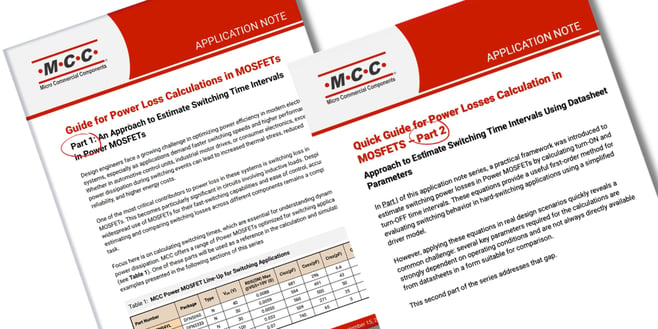
The first application note, Quick Guide for Power Losses Calculation in MOSFETs, focuses on the main loss components.
It explain how to calculate:
- Conduction losses using RDS(on) and load current
- Switching losses caused by the overlap of voltage and current during transitions
- The impact of switching frequency on total losses
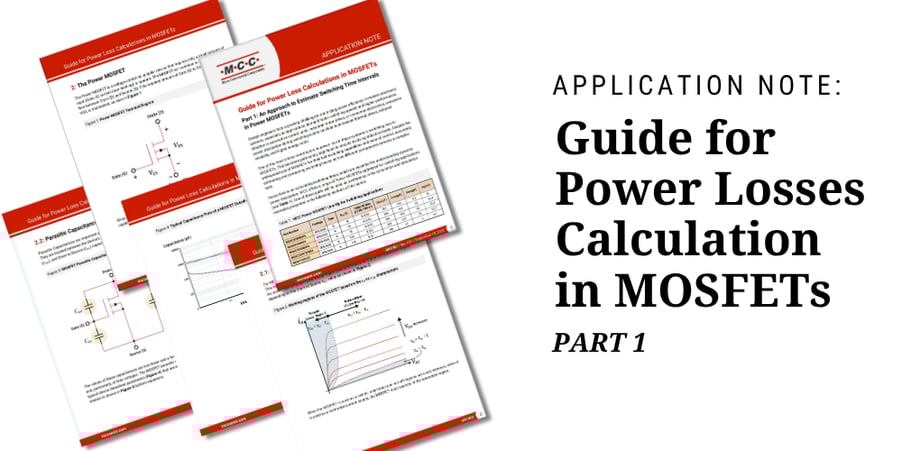
These losses are the primary contributors in most designs and form the baseline for power loss estimation.
Learn how to calculate conduction and switching losses in MOSFETs:
Application Note: Quick Guide for Power Losses Calculation in MOSFETs - Part 1
Part 2: Additional Loss Mechanisms
The second application note, Quick Guide for Power Losses Calculation in MOSFETs Part 2, Covers additional effects that contribute to total power dissipation.
These include:
- Gate drive losses from charging and discharging the gate
- Output capacitance effects during switching
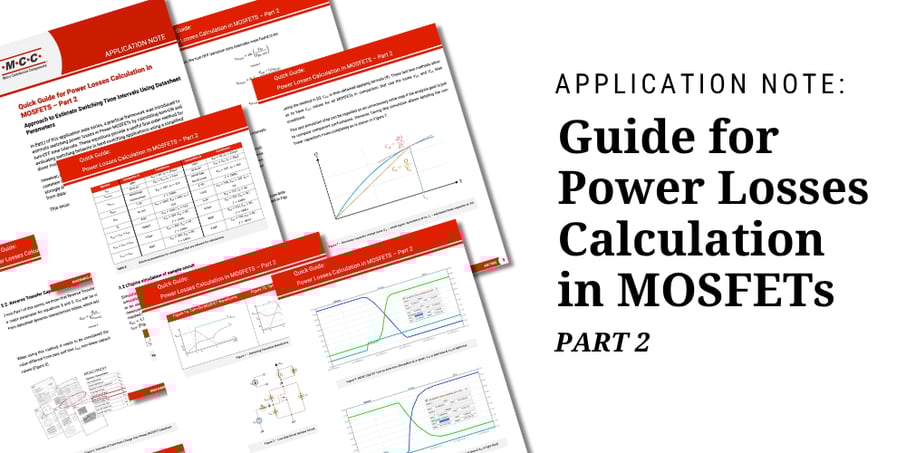
While typically smaller than conduction and switching losses, these mechanisms become increasingly important at higher switching frequencies or in efficiency-critical designs.
Explore additional MOSFET loss mechanisms including gate drive and capacitance effects:
Application Note: Quick Guide for Power Losses Calculation in MOSFETS – Part 2
Connecting Device Parameters to System Performance
Device parameters and power losses are closely related.
- RDS(on) determines conduction losses
- Gate charge influences switching losses
- Thermal resistance defines how effectively heat is removed
Evaluating these parameters together makes it easier to predict MOSFET behavior in the target application.
Supporting Efficient 40V Power Designs
40V MOSFETs are commonly used in:
- DC-DC converters
- Battery-powered systems
- Motor control circuits
In these applications, efficiency and thermal behavior are closely linked and often limited by power dissipation. Power loss analysis helps guide both device selection and overall system design.
Explore the Full Resource Set
- 40V MOSFET functions and features
- Power Loss Calculation in MOSFETs Part 1
- Power Loss Calculation in MOSFETs Part 2
From Selecting to Performance
Selecting a 40V MOSFET is only the starting point. Actual performance depends on how device parameters translate into conduction and switching losses within the circuit.
Evaluating MOSFET characteristics alongside power loss calculations provides clearer insight into efficiency and thermal behavior, and helps guide device selection and thermal design earlier in the development process.
For application support, technical questions, or sample requests, MCC offers direct engineering assistance.