Understanding fan motor technologies, 48V trends, drive configurations, and MOSFET selection for DC fan systems.
Three main fan motor technologies are commonly used today: AC fans, DC fans, and EC fans. Each technology supports different cooling requirements based on the application, power level, efficiency targets, and overall cooling system design.
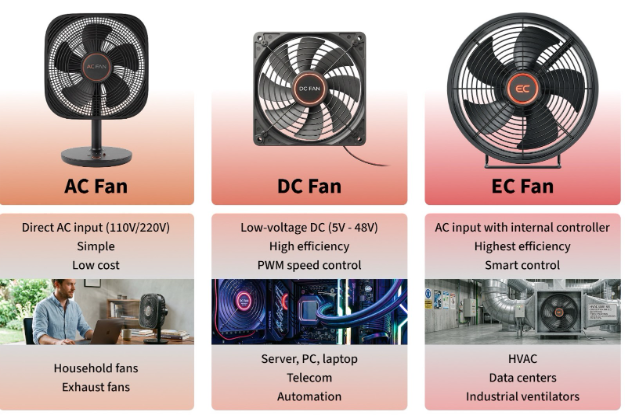
AC fans are commonly used in lower-cost and general-purpose cooling applications because of their simple design and direct AC input operation. EC fans combine AC input with an integrated controller and are widely used in HVAC systems, industrial ventilation equipment, and higher-efficiency cooling platforms.
DC fans are widely used in electronic systems because they support low-voltage operation, PWM speed control, and efficient motor performance. Common applications include servers, telecom equipment, industrial automation systems, PCs, and laptops.
Key characteristics of DC fan systems include:
-
Low-voltage operation from 5V to 48V
-
PWM speed control capability
-
Higher efficiency compared to traditional AC fan systems
-
Compatibility with compact electronic systems
-
Flexible single-phase and three-phase motor drive designs
DC Fan Voltage Overview
DC fan voltage selection depends on airflow requirements, system power, cooling requirements, and overall thermal design.
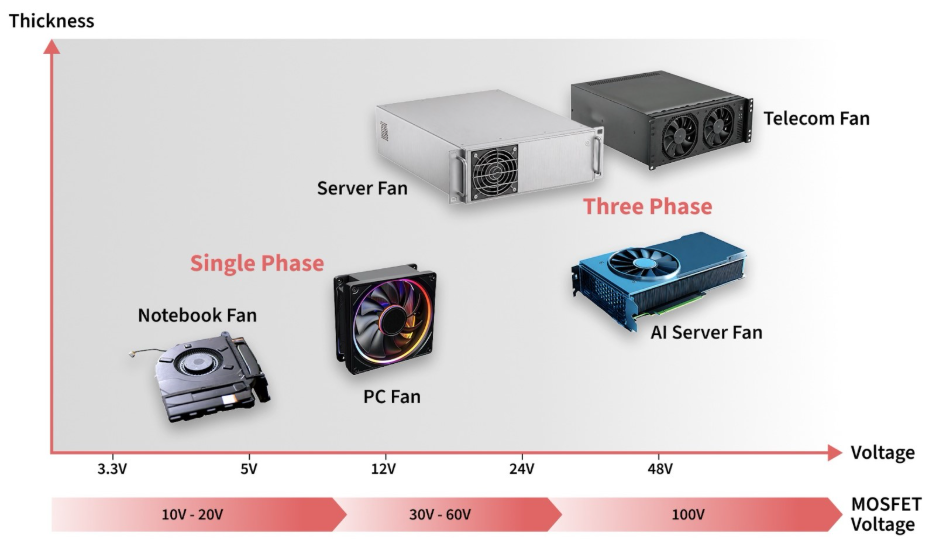
Lower-voltage fan systems remain common in notebook and PC applications, while higher-voltage designs are increasingly used in server and telecom systems. As cooling requirements increase, fan systems often transition from lower-voltage operation toward 24V and 48V designs to support higher power levels and improved efficiency.
As system power increases, fan systems require higher output power, higher rotational speeds, and improved efficiency. This is one of the main reasons 48V fan systems are becoming more common.
The transition toward 48V systems helps support:
- Higher airflow requirements
- Reduced current at higher operating voltage
- Lower conduction losses
- Improved overall system efficiency
- Higher-power cooling platforms
The increasing use of 48V server fan systems reflects the growing power density and cooling requirements in modern server designs.
As fan operating voltage increases, higher-voltage MOSFETs are required to support motor drive and power conversion functions. While lower-voltage applications may utilize MOSFETs in the 10V to 20V range, server and telecom fan designs commonly require MOSFETs rated from 30V to 60V, including 40V MOSFET solutions optimized for power switching performance, with some 48V fan systems utilizing 80V to 100V devices.
Cooling System Requirements and Fan Design
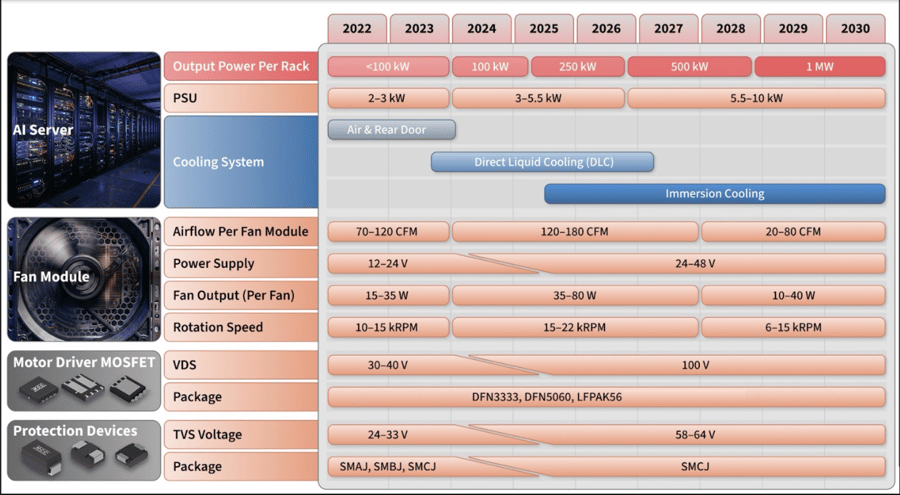
As server rack power increases, cooling system requirements also change. Higher rack power increases the thermal load placed on fan systems and directly impacts fan design, motor drive requirements, and power-stage selection.
Modern server cooling systems require higher airflow, increased fan output power, higher rotational speeds, and higher motor drive voltages to support growing power density. These trends are influencing fan design, MOSFET selection, package requirements, and protection strategies across modern cooling platforms.
Increasing rack power is driving higher airflow requirements and a transition from 12V fan systems toward 24V and 48V operation. These changes also increase fan output power, rotational speed, and motor driver voltage requirements.
As a result, greater demands are placed on:
-
DC-DC converter stages
-
Motor driver MOSFETs
-
Thermal management
-
Protection devices
-
Compact package solutions
-
Switching efficiency
DC Fan Drive Configurations
DC fan systems typically use either single-phase or three-phase motor drive configurations depending on the fan design and performance requirements. Both approaches require a DC-DC power stage and motor drive circuitry to control fan speed and system operation
The single-phase application circuit requires:
-
2 dual MOSFETs or 4 single MOSFETs
-
Reverse polarity protection using a Schottky diode and Zener diode/switch
Single-phase drive configurations provide a straightforward approach for controlling DC fan motors. The motor drive stage controls fan operation, while the protection circuitry helps protect the system from reverse polarity conditions, voltage transients, and Back EMF generated during motor operation.
Protection devices such as Schottky diodes, rectifier diodes, and Zener diodes are commonly used to help manage these conditions, improving system reliability, and protecting sensitive components from electrical stress in higher-power fan applications.
Single-Phase Application Circuit

The three-phase application circuit requires:
-
3 dual MOSFETs or 6 single MOSFETs
-
Reverse polarity protection using a Schottky diode and Zener diode/switch
Three-phase drive configurations use additional switching devices to control the motor phases and deliver the required fan performance. As fan power, airflow requirements, and system complexity increase, three-phase drive configurations may be used to meet application requirements.
Three-Phase Application Circuit
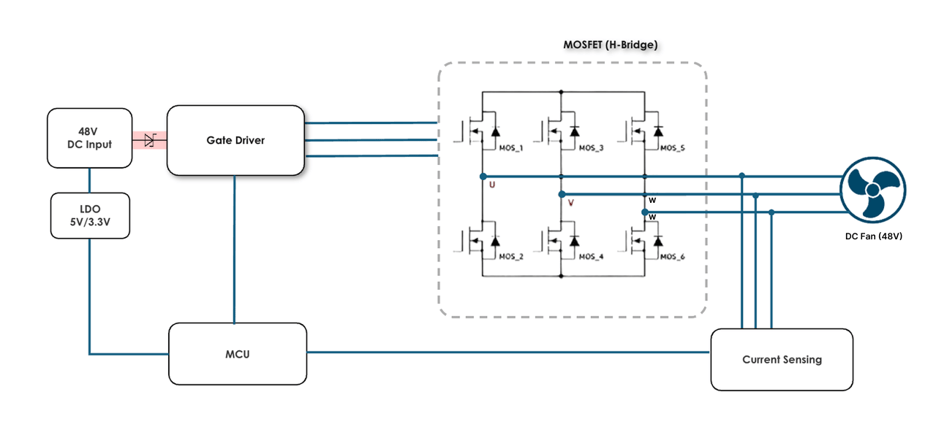
Typical DC Fan System Block Diagram
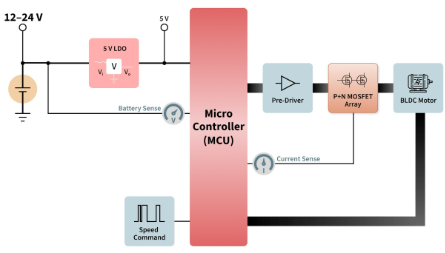
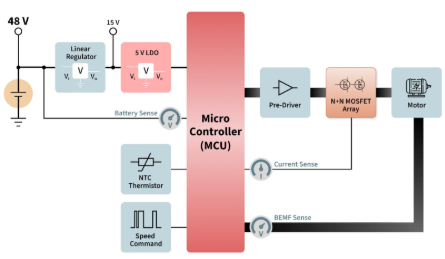
A DC fan system typically includes a controller, gate driver, MOSFET power stage, current sensing, and protection devices. Each block plays a role in controlling fan operation, improving efficiency, and protecting the system from electrical faults. Component selection within each block directly impacts efficiency, thermal performance, and overall system reliability.
The selection of MOSFETs, Schottky diodes, TVS protection devices, and gate drive components helps determine system efficiency, protection capability, and thermal performance. Understanding how these components interact within the overall system can help simplify design decisions and improve overall reliability.
DC Fan
12V / 48V DC FAN
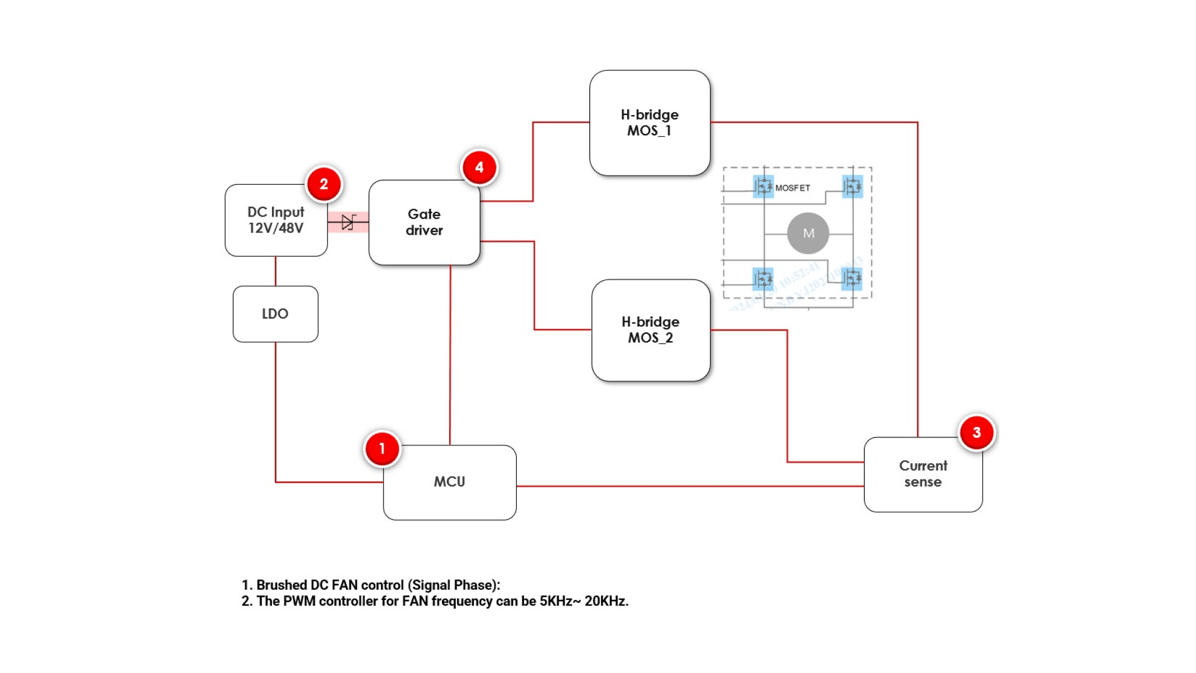
| Block# | Function | Requirement | Products Family | Package | Recommended Part |
| 1 | V Bias | 150~250mA 75~250V |
Schottky Diode | SOD-123 SOD-323 SOT-23 |
1N4148W-TP BAS21-TP BAV70-TP |
| 2 | Forward V | 1A,2A,3A 40V,60V,100V |
Schottky Barrier Rectifier |
SMA |
|
| 3 | Current Sense | 30V – 100V | MOSFET | DFN5060 DFN3333 |
MCAC47N10Y MCAC75N06Y MCGD10NP03 |
| 4 | Protection | 400W,600W,1500W 6.8~180V |
TVS | SMA-FL SMB SMC |
SMA6J18AFL-TP SMBJ10A-TP SMCJ1.5KE12A |
| Gate Driver | 30V,50V,60V | SS MOSFET |
SOT23, SOT-23 |
2N7002K-TP SI2310-TP BSS123-TP |
N+N MOSFET Configurations for 48V Systems
MOSFET selection becomes increasingly important as fan voltage and power levels increase.
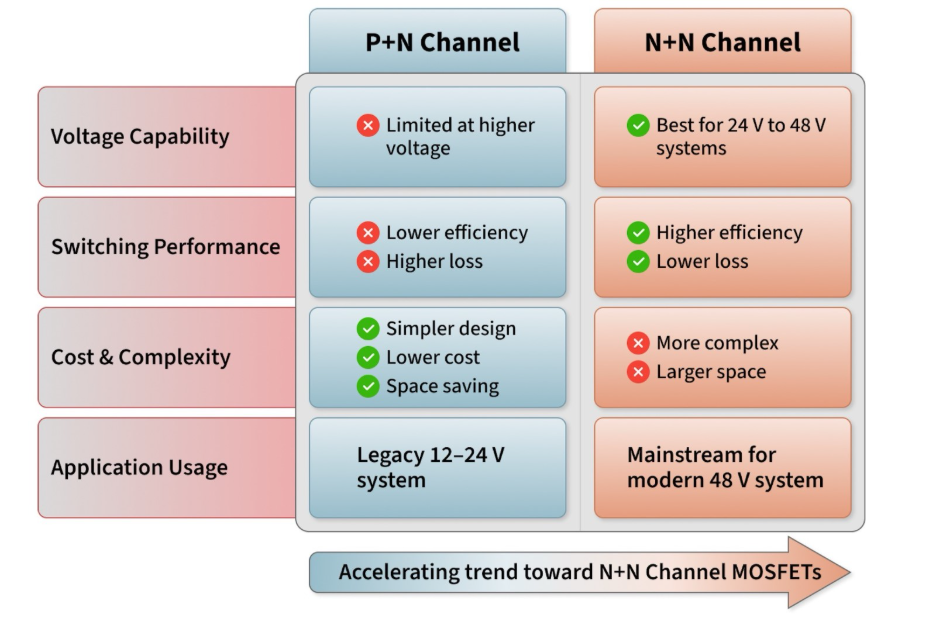
Compared to traditional P+N configurations, N+N channel MOSFET designs are becoming more common in 48V systems because they support:
- Higher efficiency
- Lower switching loss
- Lower conduction loss
- Better support for higher-voltage operation
- Improved thermal performance
P+N configurations still provide advantages in lower-voltage systems because of simpler implementation and lower overall design complexity.
For 48V fan systems, N+N channel MOSFET configurations are increasingly used to improve efficiency, reduce power loss, and support higher-performance power stages.
|
|
|
MOSFET Package Selection
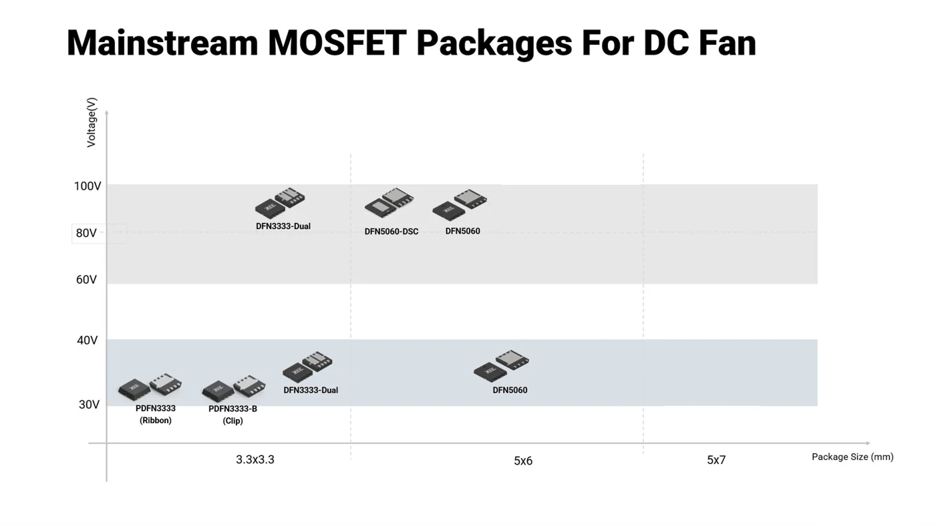
Package selection plays an important role in DC fan system design, especially in compact and thermally constrained cooling platforms.
For compact DC fan designs, DFN3333, DFN5060, and PDFN5060 Dual package options are commonly selected because they provide a balance of thermal performance, power density, and board space utilization. As fan power increases, package selection becomes an important part of the overall thermal design strategy.
Common package options for DC fan applications, include:
- DFN3333
- DFN5060
- PDFN5060
- LFPAK56
Package selection affects thermal performance, power density, switching efficiency, board space utilization, and current handling capability, making it an important consideration in compact DC fan designs.
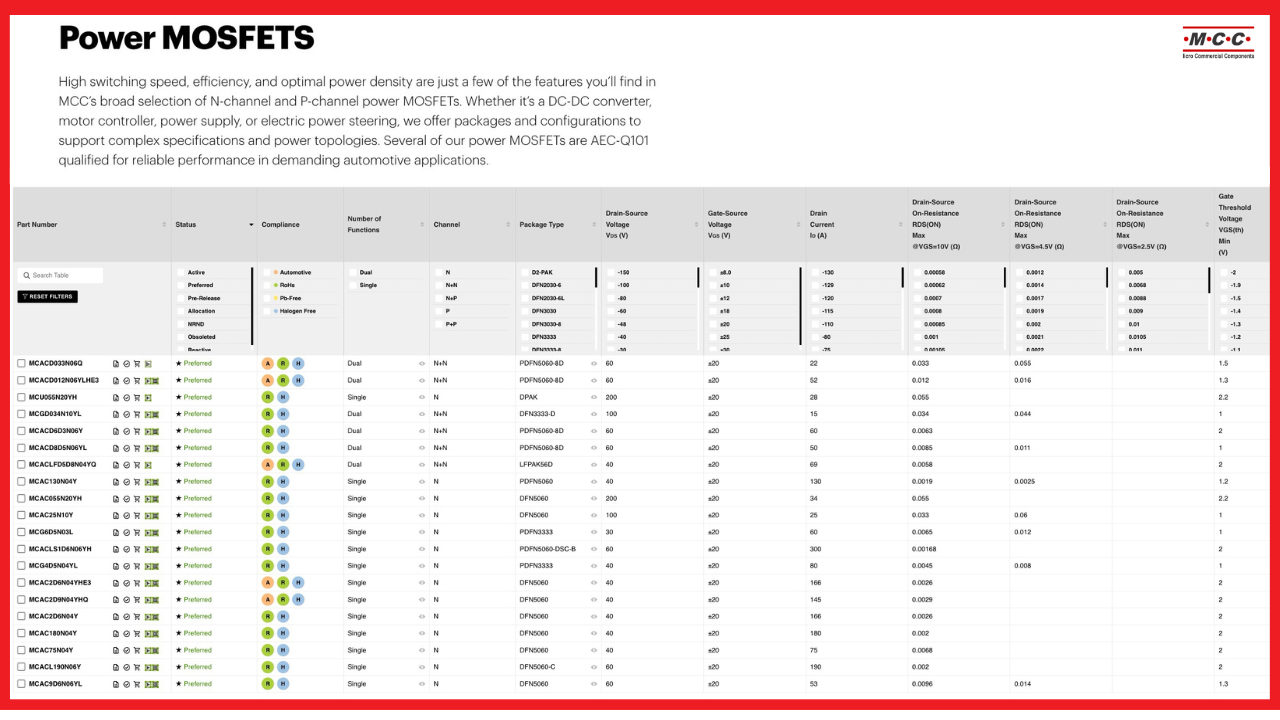
MCC offers a broad portfolio of 100V MOSFETs for 48V DC fan applications, covering both single and dual MOSFET configurations in compact surface-mount packages. The portfolio is designed to address different power levels, thermal requirements, and board space constraints, enabling designers to optimize efficiency, current capability, and PCB layout flexibility.
48V System
MCC 100V MOSFETs
Single MOS 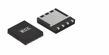
| Product |
Channel |
Package Type | VDS (V) | ID (A) | RDS(ON) Max @VGS=10V (mΩ) | VGS(th) Min (V) | VGS(th) Max (V) | Tj [max] (°C) | EAS (mJ) |
| MCACL2D4N10 YH | N | PDFN5060-CW | 100 | 312 | 2.4 | 2 | 4 | 175 | 1000 |
| MCAC4D6N10Y | N | DFN5060 | 100 | 144 | 4.6 | 2.4 | 3.4 | 150 | 225 |
| MCAC6D5N10Y | N | DFN5060 | 100 | 80 | 6.5 | 2 | 3 | 150 | 156 |
Dual MOS 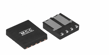
| Product | Channel | Package Type | VDS (V) | ID (A) | RDS(ON) Max @VGS=10V (mΩ) | VGS(th) Min (V) | VGS(th) Max (V) | Tj [max] (°C) | EAS (mJ) |
| MCACD20N10Y | N + N | DFN5060-8D | 100 | 20 | 22 | 1 | 2.5 | 150 | 64 |
| MCACD260N10L | N + N | DFN5060-8D | 100 | 4.9 | 260 | 1.1 | 3 | 150 | 4 |
| MCACD014N10Y | N + N | PDFN5060-8D | 100 | 50 | 14 | 1 | 3 | 150 | 49 |
48V DC Fan Reference Design
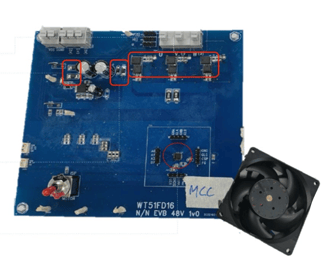
MCC has developed a 48V DC fan discrete and control solution designed for server and telecom cooling applications
The platform demonstrates how power MOSFETs, protection devices, and motor control solutions can be integrated into a complete 48V DC fan design. By combining the power stage, protection circuitry, and BLDC motor controller into a single platform, the design provides a practical example of a 48V fan implementation.
|
Function |
Device |
|
|
Power Stage |
MCAC38N10Y 100V Low RDS(on) MOSFET
|
|
|
Schottky Protection |
SMD310HE 1100V, 3A Schottky Diode
|
|
|
TVS Protection |
SMF70A 200W, 70V TVS Diode |
|
|
Motor Control |
8-bit BLDC Motor Controller |
|


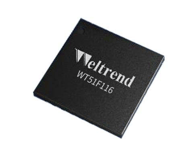
48V DC Fan Discrete + Control Solution
Optimized Discrete Solution for 48V AI Server Cooling
1. Power Stage
|
 |
2. Protection |
|
3. Controller
|