What Is ESD Protection and Why It Matters
ESD protection refers to the design practices and components, primarily ESD protection diodes, TVS diodes, and OVP devices that prevent electrostatic discharge from damaging sensitive electronics.
Real-world ESD events can exceed tens of thousands of volts with sub-nanosecond rise times. Without proper protection, ESD and electrical overstress (EOS) can cause:
- IC and transceiver damage
- USB port failures
- Ethernet PHY failures
- Latch-up events
- Long-term reliability problems
There are several models developed to simulate an ESD event. Below table shows the industrial standards:
|
ESD model |
Application level |
Simulated event |
Test conditions |
Peak voltage |
Peak current |
Stored energy |
|
HBM (JS-001) |
Component level |
A person who has built up static charge (e.g., by walking on a carpet) and then discharges that energy directly through their finger when touching an electronic device |
100 pF / 1.5 kΩ Tr = 2–10 ns Td = ~150–200 ns |
Up to 8 kV |
~5.3 A (at 8 kV) |
3.2 mJ |
|
CDM (JS-002) |
Component level |
A scenario where the device itself becomes charged (e.g., sliding down a production line) and then discharges all its stored energy instantly when one of its pins touches a grounded surface |
Device‑dependent* / < 1 Ω Tr = 0.1–0.5 ns Td = ~1–8 ns |
Up to 1 kV (or higher) |
5–20 A (at 500 V) |
~2 µJ (for 4 pF at 1 kV) |
|
IEC 61000-4-2 |
System level |
A more energetic event where a charged person, often holding a metal tool like a key or screwdriver, discharges directly into a finished, operational electronic product |
150 pF / 330 Ω Tr = 0.7–1 ns Td = ~60–100 ns |
Up to 30 kV (air) |
~30 A (at 30 kV) |
67.5 mJ |
|
ISO 10605 |
Automotive system level |
A discharge from a charged metal object (like a repair tool, fuel nozzle, or a car's metal door frame) to an electronic module inside a vehicle |
330 pF / 330 Ω Tr = 0.7–1 ns Td = ~50–100 ns |
Up to 30 kV |
~112.5 A (at 30 kV)** |
148.5 mJ (at 30 kV) |
|
|
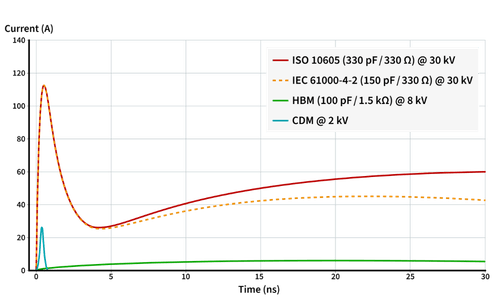
|
|
ESD Waveform Comparison (0-200ns) @30kV Max Stress |
Initial ESD Waveform Comparison (0-30ns) @30kV |
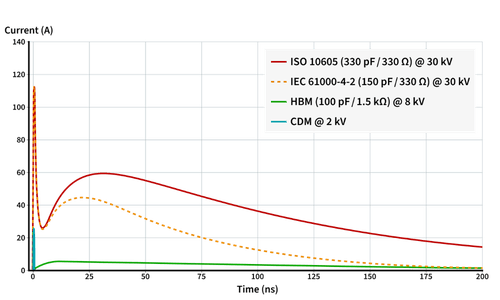
Internal IC protection is designed only for device-level HBM and CDM handling events and cannot withstand IEC 61000-4-2 system-level ESD exposure through external connectors. External ESD and TVS protection devices are required at every exposed interface.
USB ESD Protection for USB-C, USB 3.x, and USB4
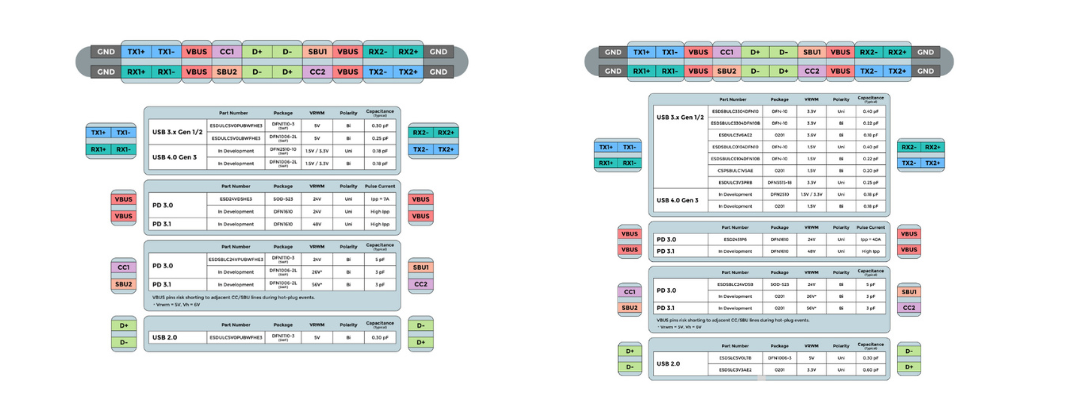
USB-C combines high-voltage power delivery, sensitive control signals, and multi-gigabit data channels within a compact connector. This combination makes USB interfaces especially vulnerable to ESD, electrical overstress, and hot-plug events, particularly when CC and SBU pins are exposed to transient shorts with VBUS during insertion or removal.
Effective USB ESD protection requires a coordinated approach that includes overvoltage protection for CC and SBU pins, high-current TVS diodes for VBUS rails up to 48 V, and ultra-low-capacitance ESD diodes for USB 3.x and USB4 differential pairs to preserve signal integrity.
A detailed design guide with device recommendations, placement strategies, and automotive considerations is available here:
Ethernet ESD Protection from 100BASE-T1 to 10GbE
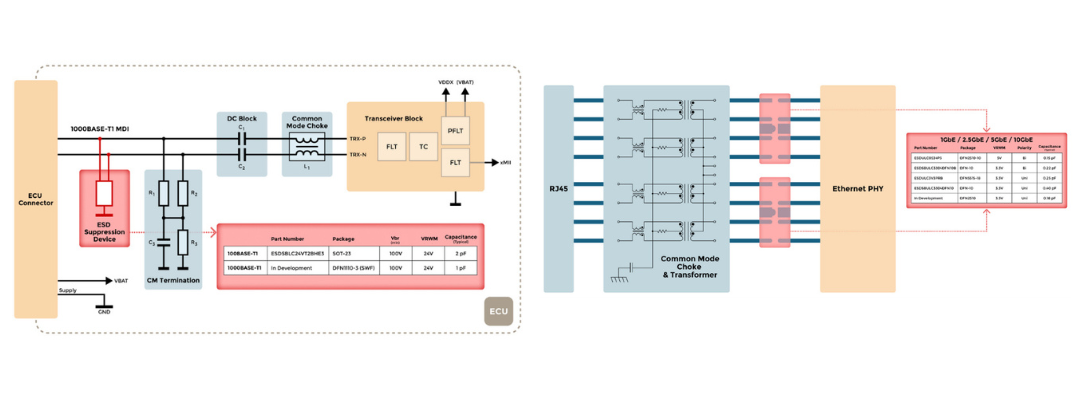
Ethernet interfaces are highly sensitive to ESD because even small parasitic capacitances can degrade differential signaling, especially at gigabit and multi-gigabit speeds. ESD can enter through RJ45 connectors, cable shields, or LED control pins and propagate toward the PHY if not properly suppressed.
Robust Ethernet ESD protection focuses on ultra-low-capacitance ESD diodes placed on the secondary side near the PHY, with strategies that balance immunity against IEC 61000-4-2 requirements while maintaining return loss and insertion loss performance. Automotive Ethernet adds further challenges, requiring compliance with OPEN Alliance EMC guidelines and resilience to higher discharge levels.
Recommended protection approaches and device examples are covered in detail here:
Ultimate Ethernet ESD Protection: High-Performance Devices from MCC
Video and Display ESD Protection for HDMI, DisplayPort, and LVDS
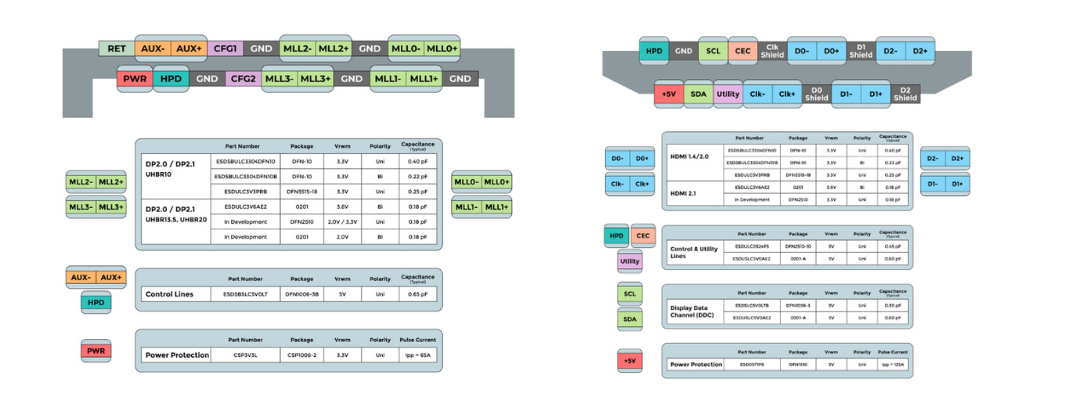
High-speed video and display interfaces operate with extremely tight signal integrity margins, making them some of the most ESD-sensitive connections in modern electronics. Even minimal capacitance or asymmetry introduced by protection components can distort eye diagrams and reduce link reliability.
ESD protection for video interfaces requires ultra-low-capacitance ESD diodes placed directly at the connector, with careful attention to symmetrical loading across differential pairs. These devices must provide fast clamping for connector discharge events while remaining electrically transparent at high data rates.
Design considerations and optimized solutions for video and display interfaces are explored here:
Next-Gen Video ESD Protection: High-Performance Solutions from MCC
Explore MCC ESD and TVS protection devices for high-speed, power, and automotive applications.